

If your procurement strategy depends on an accurate price forecast,
then the forecast itself becomes a risk
PRICES WILL MOVE. KNOW WHAT YOU’LL DO WHEN THEY DO.
Energy markets have become harder to forecast and more expensive to get wrong.
Yet most procurement decisions still assume that, with enough data and modelling, the uncertainty will shrink until a clear answer emerges.
In energy markets, it rarely does.


Run your current procurement strategy across thousands of gas and power price futures using large-scale Monte Carlo simulation. Understand the market conditions where your strategy holds and where it breaks.
PRICE SCENARIO STRESS-TESTING
COST AND RISK TRADE-OFFS
Plot all your strategies on a frontier of expected cost against downside exposure. Procurement and finance teams can see what each option costs in a normal year and what it risks in a bad one.
Our mission is to give energy-intensive businesses procurement strategies they can defend in any market, with rules their teams can act on.
By testing strategies across thousands of price futures and against past shocks, we show the trade-off between cost and risk in terms that you can actually work with.

RISK APPETITE CALIBRATION
Draw out your organisation’s appetite for cost and volatility and turn this into a rules-based handbook that sets out when to hedge, when to lock in and when to hold.
Set signposts on price levels and market conditions, so your team knows when to hedge, lock in or hold.

Adaptive MARKET TRIGGERS
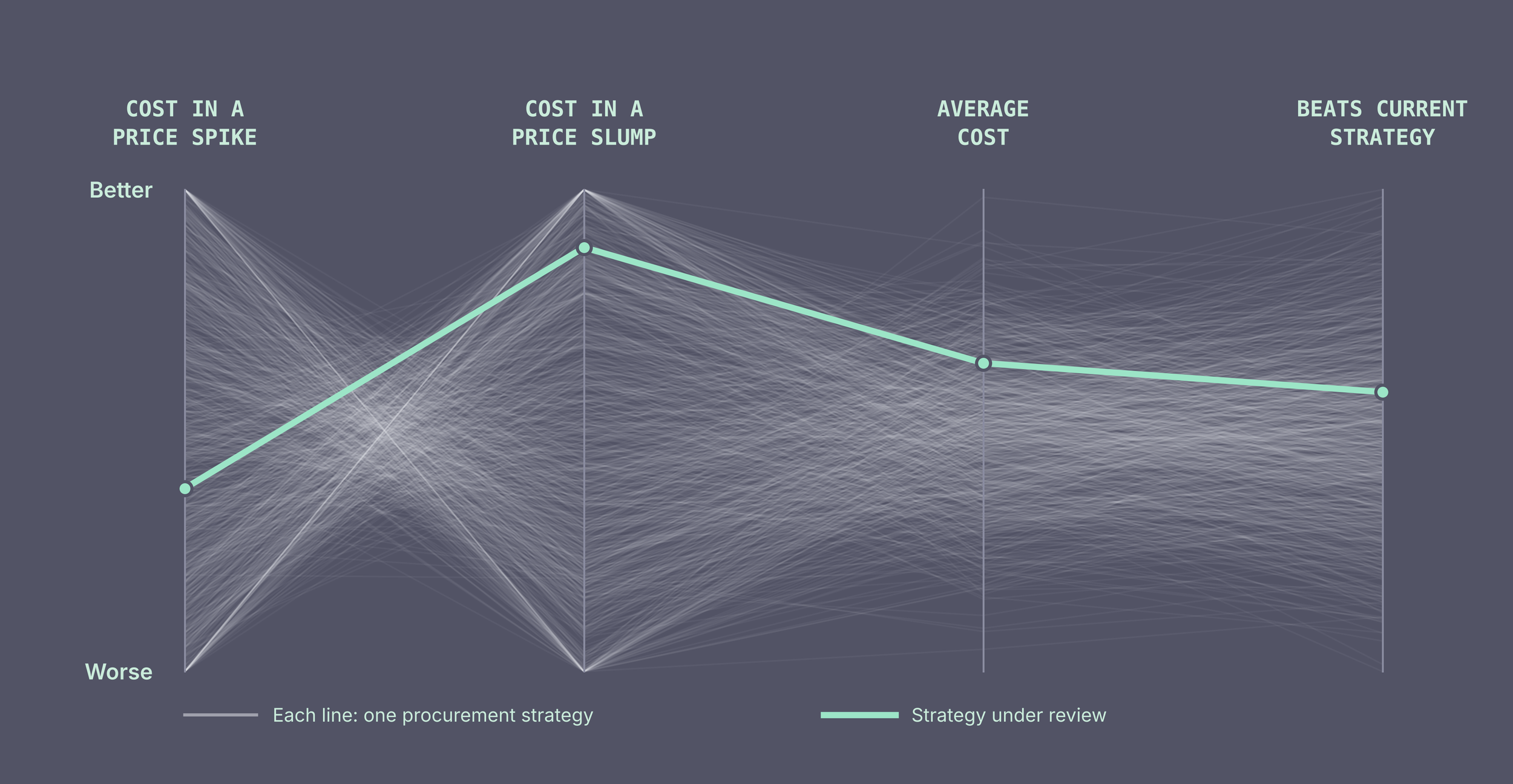
SEE EVERY STRATEGY AT ONCE.
Every grey line is a procurement strategy, tested across thousands of price futures. Each axis is something your board cares about: what you pay when prices spike, what you pay when they fall, what you pay on average, and how often you beat your current approach.
The highlighted strategy does well when prices fall and is exposed when they rise. Foresight helps you find the strategy whose trade-offs match how much risk your business is willing to carry.
How an engagement works
We take your current procurement strategy and run it across thousands of price futures, then tests it against past market shocks. Alternative strategies are plotted on an efficient frontier of expected cost against downside exposure, so you can see how your approach compares.
DIAGNOSE
1
In structured workshops with your finance and procurement leads, we draw out how much cost and volatility the business is prepared to accept. Those preferences are used to create a rules-based framework, setting out when to hedge, when to lock in and when to hold, with the reasoning your board can review.
CALIBRATE
2
The rules and signposts are set up in Nebula, where your team can track them against live market conditions. We then review them with you each quarter and recalibrate as your exposure or risk appetite changes.